
HOW OXYCODONE RELIEVES SEVERE PAIN
INTRODUCTION
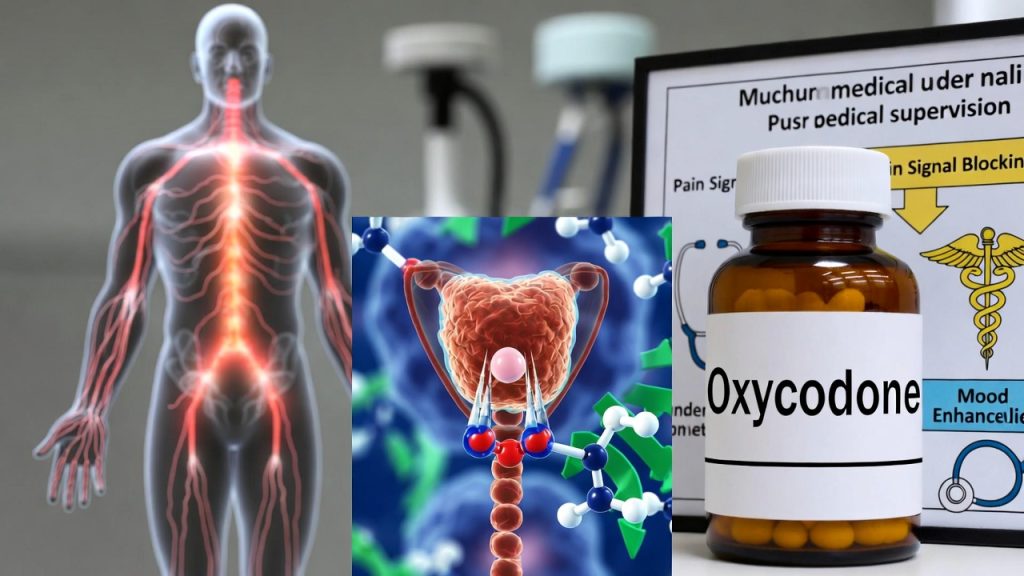
Oxycodone is one of the most commonly prescribed opioid medications for the management of severe pain. As a potent semi-synthetic opioid, it is frequently used when non-opioid analgesics or weaker opioids fail to provide adequate relief. Understanding how oxycodone relieves severe pain requires examining its interaction with the body’s pain signaling pathways, from receptor binding at the molecular level to the subjective experience of reduced pain perception.
This article provides a detailed, evidence-based exploration of the mechanisms by which oxycodone produces analgesia, particularly in cases of severe acute or chronic pain. We will cover the pharmacological basis of its action, the neurobiological processes involved, clinical contexts where it is most effective, the factors that influence its pain-relieving efficacy, associated benefits and limitations, risks, side effects, safety considerations, frequently asked questions, and a concluding summary.
The discussion remains strictly educational and neutral. Oxycodone is a Schedule II controlled substance with significant potential for misuse, dependence, and life-threatening respiratory depression. Its use should always occur under close medical supervision following current clinical guidelines. The goal here is to offer readers a clear, in-depth understanding of the science behind oxycodone’s analgesic effects so they can better appreciate both its therapeutic value and its inherent dangers.
HISTORICAL CONTEXT OF OPIOID ANALGESIA
DISCOVERY AND EARLY UNDERSTANDING OF OPIOIDS
The pain-relieving properties of opium have been known for millennia, with references dating back to ancient Sumerian, Egyptian, and Greek texts. Morphine, isolated from opium in 1804, became the first pure opioid alkaloid used in medicine. By the early 20th century, chemists sought to modify morphine’s structure to retain analgesia while reducing side effects and abuse liability.
Oxycodone was synthesized in 1916 by German researchers Freund and Speyer through the oxidation of thebaine, another opium alkaloid. Marketed initially as Eukodal, it demonstrated strong analgesic potency with a somewhat different side-effect profile compared to morphine. Its widespread clinical adoption, especially after the introduction of controlled-release formulations in the 1990s, highlighted both its effectiveness in severe pain and the challenges of widespread opioid prescribing.
MODERN UNDERSTANDING OF PAIN PATHWAYS
Contemporary pain science recognizes pain as a complex, multidimensional experience involving sensory, emotional, and cognitive components. Nociception—the detection of noxious stimuli—begins with peripheral nociceptors that transmit signals via Aδ and C fibers to the dorsal horn of the spinal cord. These signals ascend through the spinothalamic tract to the thalamus and then to cortical and limbic regions responsible for pain perception and emotional response.
Opioids, including oxycodone, primarily interrupt this pathway at multiple levels: peripherally (to a lesser extent), spinally, and supraspinally. Their ability to produce profound analgesia in severe pain states stems from this multi-site action on the nociceptive system.
PHARMACOLOGY OF OXYCODONE
CHEMICAL STRUCTURE AND CLASSIFICATION
Oxycodone (4,5α-epoxy-14-hydroxy-3-methoxy-17-methylmorphinan-6-one) is a semi-synthetic derivative of thebaine. It belongs to the phenanthrene class of opioids and acts primarily as a full agonist at mu-opioid receptors (MOR), with lesser activity at kappa- and delta-opioid receptors.
Its structure includes a phenolic hydroxyl group at position 3 (essential for receptor binding), a ketone at position 6, and a methyl group on the nitrogen, contributing to its pharmacokinetic and pharmacodynamic profile.
RECEPTOR AFFINITY AND SELECTIVITY
Oxycodone binds with high affinity to mu-opioid receptors, particularly the mu-1 subtype associated with analgesia and the mu-2 subtype linked to respiratory depression and euphoria. Studies using cloned human receptors show oxycodone has approximately 5–10 times less affinity for MOR than morphine on a molar basis, yet its in vivo potency is roughly 1.5 times greater than morphine when given orally. This discrepancy is attributed to active metabolites and differences in blood-brain barrier penetration.
Oxycodone also exhibits some kappa-receptor agonism, which may contribute to its analgesic effects in certain pain states (e.g., visceral pain) and to side effects such as dysphoria in sensitive individuals.
ACTIVE METABOLITES
Oxycodone undergoes hepatic metabolism primarily via CYP3A4 (to noroxycodone) and CYP2D6 (to oxymorphone). Oxymorphone is a significantly more potent mu-agonist (approximately 10–14 times more potent than morphine), but it constitutes only a small fraction (≈10–15%) of oxycodone’s metabolites in most individuals. Genetic polymorphisms in CYP2D6 can therefore influence both efficacy and toxicity:
- Poor metabolizers may experience reduced analgesia due to lower oxymorphone formation.
- Ultra-rapid metabolizers may achieve higher oxymorphone levels, increasing risk of adverse effects.
CELLULAR AND MOLECULAR MECHANISMS OF ANALGESIA
MU-OPIOID RECEPTOR ACTIVATION
When oxycodone binds to presynaptic mu-opioid receptors on nociceptive neurons, it activates inhibitory G-proteins (Gi/Go). This leads to:
- Inhibition of adenylyl cyclase → decreased cyclic AMP → reduced activity of protein kinase A.
- Opening of inwardly rectifying potassium channels → membrane hyperpolarization → decreased neuronal excitability.
- Closure of voltage-gated calcium channels → reduced calcium influx → decreased release of excitatory neurotransmitters (glutamate, substance P, CGRP).
These actions occur at multiple sites: primary afferent terminals in the dorsal horn, interneurons in the spinal cord, and descending modulatory pathways originating in the periaqueductal gray (PAG) and rostral ventromedial medulla (RVM).
SPINAL AND SUPRASPINAL ANALGESIA
At the spinal level, oxycodone reduces transmitter release from primary afferents and hyperpolarizes dorsal horn projection neurons, thereby diminishing ascending pain signals.
Supraspinally, activation of mu-receptors in the PAG and RVM activates descending inhibitory pathways that release serotonin and norepinephrine in the spinal cord, further suppressing nociceptive transmission (a process known as descending inhibition).
Oxycodone also modulates pain perception by acting on limbic structures (amygdala, anterior cingulate cortex), reducing the affective component of pain—the unpleasant emotional experience—even when some sensory aspects persist.
PERIPHERAL CONTRIBUTIONS
Although less prominent, peripheral mu-opioid receptors on sensory nerve endings and immune cells can be activated, particularly in inflamed tissues where receptor expression is upregulated. This contributes to analgesia in inflammatory and postoperative pain states.
PHARMACOKINETICS RELEVANT TO ANALGESIC EFFECT
ABSORPTION AND ONSET
Immediate-release oxycodone reaches peak plasma concentrations in 1–2 hours, providing relatively rapid onset of analgesia (15–30 minutes). Extended-release formulations are designed to provide steady-state levels over 12 hours, minimizing peak-trough fluctuations that can lead to breakthrough pain or side effects.
DISTRIBUTION AND CNS PENETRATION
Oxycodone is moderately lipophilic, allowing efficient crossing of the blood-brain barrier. Its volume of distribution is approximately 2–3 L/kg, and protein binding is low (≈45%), facilitating rapid equilibration between plasma and CNS.
ELIMINATION AND DURATION
The elimination half-life of immediate-release oxycodone is 3–4.5 hours, while extended-release forms exhibit apparent half-lives of 4.5–8 hours due to slow absorption. Analgesic duration typically ranges from 4–6 hours (IR) to 8–12 hours (ER).
Renal and hepatic impairment prolong half-life and increase risk of accumulation.
CLINICAL CONTEXTS WHERE OXYCODONE RELIEVES SEVERE PAIN
ACUTE SEVERE PAIN
- Postoperative pain (orthopedic, abdominal, thoracic surgery)
- Traumatic injuries (fractures, burns, crush injuries)
- Acute sickle cell crisis
- Renal colic and biliary colic
In these settings, oxycodone is often administered as part of multimodal analgesia, combined with acetaminophen, NSAIDs, regional anesthesia, and non-pharmacologic techniques.
CANCER-RELATED SEVERE PAIN
Oxycodone is widely used for breakthrough pain and background pain in advanced cancer, particularly bone metastases, neuropathic pain from tumor invasion, and visceral pain from organ obstruction.
CHRONIC NON-CANCER PAIN
Although controversial and generally discouraged for long-term use, oxycodone is sometimes prescribed for severe chronic pain (e.g., severe osteoarthritis, failed back surgery syndrome, severe peripheral neuropathy) when benefits clearly outweigh risks and after exhaustive non-opioid trials.
BENEFITS OF OXYCODONE’S ANALGESIC MECHANISM
- Rapid, potent relief of severe pain
- Effective against both nociceptive and some neuropathic pain components
- Multiple routes of administration (oral, intravenous, rectal)
- Availability of immediate- and extended-release formulations
- Reduction in pain-related suffering, improved sleep, and enhanced function when used appropriately
LIMITATIONS AND FACTORS AFFECTING ANALGESIC EFFICACY
- Development of tolerance (reduced response over time)
- Opioid-induced hyperalgesia (paradoxical increase in pain sensitivity)
- Incomplete cross-tolerance between different opioids
- Individual variability due to genetics, age, sex, concurrent medications
- Diminishing returns in neuropathic pain compared to nociceptive pain
RISKS AND ADVERSE EFFECTS RELATED TO ANALGESIC MECHANISM
RESPIRATORY DEPRESSION
The most dangerous effect: mu-2 receptor-mediated reduction in respiratory drive, particularly at higher doses or in opioid-naïve patients.
SEDATION AND COGNITIVE IMPAIRMENT
Resulting from cortical and brainstem mu-receptor activation.
CONSTIPATION
Strong mu-mediated inhibition of gastrointestinal motility.
ENDOCRINE EFFECTS
Suppression of hypothalamic-pituitary-gonadal axis leading to hypogonadism, reduced bone density.
IMMUNOMODULATION
Potential suppression of immune function with chronic use.
ADDICTION AND MISUSE POTENTIAL
Euphoria from mu-receptor activation in reward pathways (mesolimbic dopamine system).
SAFETY CONSIDERATIONS FOR MAXIMIZING ANALGESIA WHILE MINIMIZING RISK
- Start low, go slow titration
- Use lowest effective dose for shortest duration necessary
- Multimodal analgesia to reduce opioid requirements
- Risk stratification and monitoring (PDMP checks, urine drug testing)
- Naloxone co-prescription for overdose reversal
- Patient education on safe storage, disposal, and signs of overdose
FREQUENTLY ASKED QUESTIONS
- How quickly does oxycodone relieve severe pain?
- Why is oxycodone more effective than over-the-counter painkillers for severe pain?
- Does oxycodone work for nerve pain?
- How does tolerance affect oxycodone’s ability to relieve pain?
- Can oxycodone make pain worse over time?
- Is oxycodone safe for long-term severe pain?
- What should I do if oxycodone stops working as well?
- How does oxycodone compare to morphine for severe pain relief?
CONCLUDING SUMMARY
Oxycodone relieves severe pain through potent, multi-level activation of mu-opioid receptors, inhibiting nociceptive transmission at peripheral, spinal, and supraspinal sites while also modulating the emotional experience of pain. Its pharmacokinetic profile supports rapid and sustained analgesia in appropriately selected patients.
However, the same mechanisms responsible for its therapeutic effects also underlie serious risks including respiratory depression, tolerance, dependence, and overdose. Modern pain management therefore emphasizes careful patient selection, multimodal approaches, vigilant monitoring, and adherence to evidence-based guidelines that prioritize non-opioid therapies whenever possible.
Understanding how oxycodone relieves severe pain empowers patients and clinicians to use it judiciously—when truly indicated—as one component of a comprehensive pain care plan rather than a default or long-term solution.